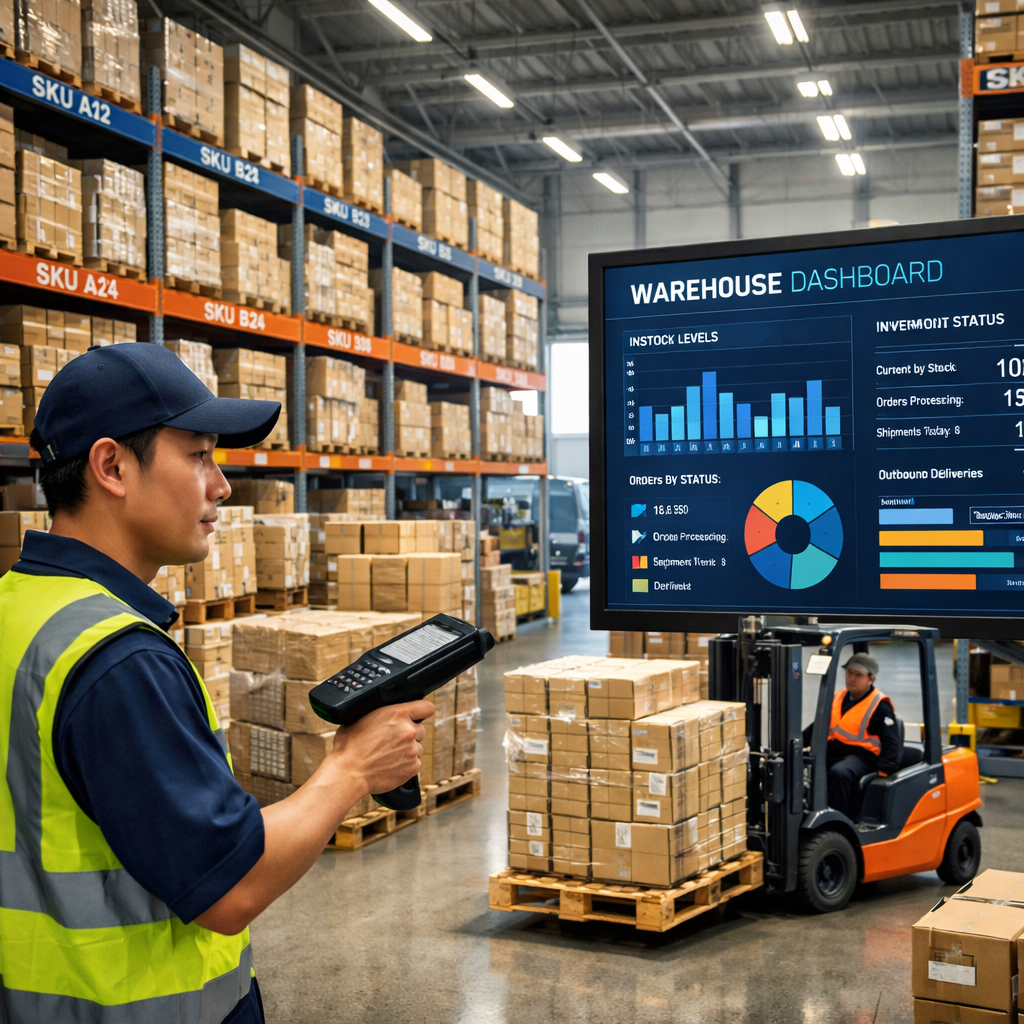

Most brands implement a warehouse stock management system and stop there. They get real-time stock levels, barcode scanning, accurate pick rates and assume the job is done. It 's not.
Managing stock in a warehouse is one problem. Managing stock across your business, channels, warehouses, 3PLs, and supplier lead times. This is a different problem entirely. And most warehouse stock management systems were only built to solve the first one.
What "Stock Management" Actually Means at Scale
At the basic level, a warehouse stock management system handles the operational side of inventory:
- Receiving and putaway: Logging inbound stock, assigning locations
- Real-time stock levels: Knowing how many units are in each bin, shelf, or zone
- Movement tracking: Recording every pick, transfer, adjustment, and shipment
- Replenishment triggers: Alerting when stock drops below a set threshold
- Cycle counting: Keeping physical counts aligned with system records
- Lot and batch tracking: Critical for regulated or perishable categories
This is table stakes. And if you don't have it, everything downstream is broken. Inaccurate stock records lead to overselling, picking errors, delayed shipments, and customer complaints.
But once you have it. Once your warehouse operations are clean and your stock records are accurate. A harder question emerges: now what do you do with that information?
The Stock Management Problem Nobody Talks About
Here's the scenario most multi-channel brands find themselves in:
Your warehouse stock management system tells you that you have 800 units of your best-selling SKU across three locations. Accurate. Real-time. Clean data.
What it doesn't tell you:
- Where those 800 units should go.
Is it better to keep them in your own warehouse for Shopify orders, move them to FBA for Amazon velocity, or hold some back for your wholesale account? - Whether 800 is enough.
If your average daily sales across all channels are 40 units and your next inbound shipment is 25 days out, you have a stockout problem. But your WMS just says "800 units available." - What to order next.
Should you reorder 1,000, 2,000, or 5,000 units? What's the right quantity given lead time, current demand, seasonality, and your cash position? - What to do when stock is limited. If you only have 200 units and demand from three channels exceeds that, which channel gets priority, and what's the revenue impact of each allocation choice?
These are stock management questions. Real ones. And no warehouse stock management system answers them well, because they require forecasting, simulation, and business logic. That is not just operational tracking.
Where Warehouse Stock Management Systems Hit Their Ceiling
The core limitation is architectural. A warehouse stock management system is designed to reflect the present state of your inventory. It's a system of record, not a system of decision.
It answers: What do I have?
It does not answer: What should I do?
The gap between those two questions is where most brands lose money. Stockouts in high-demand channels, overstock sitting idle in low-demand locations, purchase orders placed too late or for the wrong quantity. These aren't failures of warehouse operations. They're failures of stock management at the business level.
Specifically, here's what a WMS cannot do:
- Forecast demand by SKU across each of your sales channels over the next 30 to 90 days.
- Project future stock positions at each warehouse or 3PL given current sales velocity and inbound POs.
- Recommend how to split available inventory across channels based on service level targets.
- Calculate the optimal reorder quantity balancing stockout risk, capital efficiency, and supplier minimums.
- Simulate how a planned promotion or seasonal spike will affect your stock runway.
These capabilities require a different type of system. One that sits on top of your warehouse data and uses it to drive decisions.
The Missing Layer: Stock Management as a Business Decision
Think of your tech stack in three layers:
Layer 1: Sales channels - Where demand originates (Shopify, Amazon, wholesale portals, B2B)
Layer 2: Warehouse and fulfillment — Where stock physically lives (your own warehouse, 3PLs, FBA)
Layer 3: Decision layer — Where you decide how to connect layers 1 and 2
Most brands have layers 1 and 2 covered. Layer 3 is usually a spreadsheet, or nothing at all.
The decision layer is what transforms warehouse data into business actions: what to buy, how much, when, from which supplier, and where to allocate it across channels.
Without it, you're flying with accurate instruments but no flight plan.
How Flieber Completes Your Stock Management Stack
Flieber is the decision layer for modern commerce brands. It connects to your existing systems, like warehouse management, 3PLs, FBA, Shopify, Amazon, and uses the data those systems generate to answer the questions they can't.
Here's how it works in practice:
Demand Forecasting by Channel
Instead of looking at aggregate sales history, Flieber breaks demand down by SKU and by channel. It accounts for seasonality, trends, and planned events like promotions or product launches. The result is a forward-looking demand picture across every sales channel, not just a backward-looking average.
This matters because demand rarely moves uniformly. Your Amazon volume might be accelerating while your Shopify DTC is flat. Treating them as one number leads to systematic misallocation.
Inventory Forecasting Across Locations
Flieber projects future stock positions at each node in your fulfillment network. Your warehouse, your 3PL, FBA are over a rolling horizon. It combines current on-hand inventory, open purchase orders, expected transfers, and the demand forecast to show you exactly where your stock will be in 30, 60, and 90 days.
You see stockouts before they happen. You see overstock building before you're locked in. The response time goes from reactive (after the stockout) to proactive (weeks ahead).
Allocation Recommendations
When you're deciding how to split available stock across channels, or when new inventory arrives and needs to be distributed. Flieber generates specific allocation recommendations based on demand, service level targets, and channel priorities you define.
This turns a weekly spreadsheet exercise into a repeatable, consistent process guided by data.
Replenishment Recommendations
For each SKU, Flieber calculates when to reorder and how much, factoring in supplier lead times, minimum order quantities, safety stock targets, and working capital constraints. The output is a purchase order list, not a report to interpret.
The shift is significant: instead of your team building a replenishment plan from scratch every week, they review and approve recommendations.
Simulation Before Commitment
Before you execute any major inventory decision, a large PO, a channel reallocation or a promotional campaign, Flieber lets you model the outcome. What does your stock position look like in 60 days if you run a 20% discount next month? What happens if your supplier's lead time extends by two weeks?
This capability removes the guesswork from high-stakes inventory decisions.
A Practical Example: The Same 800 Units, Better Decisions
Back to the scenario from earlier. You have 800 units of your best-selling SKU spread across your warehouse, your 3PL, and FBA.
A warehouse stock management system sees three separate stock positions. Flieber sees one pool of 800 units, and asks a single question: what's the best way to deploy this inventory given total demand across all channels?
With that unified view, the decisions change completely:
- Total demand picture: Across Amazon, Shopify, and wholesale, projected demand for the next 30 days is 750 units. You're not oversupplied. You have roughly 50 units of buffer across your entire operation.
- Reorder signal: With a 22-day supplier lead time and 750 units of demand in the next 30 days, Flieber flags a reorder now. It happens before any individual channel shows a stockout alert.
- Allocation logic: Rather than managing each channel in isolation, Flieber recommends how to position those 800 units across your network to maximize coverage and minimize the risk of a stockout in any channel.
Same 800 units. Completely different decision quality.
Signs Your Stock Management Needs a Decision Layer
You probably need more than a warehouse stock management system if:
- You're managing allocation in spreadsheets.
If someone spends more than 2 hours a week deciding where to send inventory, the process isn't scaling. - Stockouts and overstock coexist.
Running out of stock in one channel while sitting on excess in another is almost always an allocation and forecasting failure, not a warehouse failure. - Purchase orders are reactive.
If you're placing emergency orders because you didn't see the stockout coming, your planning horizon is too short. - You can't simulate before you commit.
If a major promotion requires a full day of spreadsheet modeling to understand inventory implications, that's a gap. - Your WMS data isn't driving purchasing decisions.
If your buyer isn't actively using warehouse data when placing orders, the data loop is broken.
Getting Started: What the Stack Looks Like in Practice
You don't need to replace your warehouse stock management system. You need to connect it to a planning layer.
Step 1: Clean up your foundation.
Get inventory accuracy above 95%. Make sure your WMS is syncing correctly with your main sales channels. Resolve SKU naming inconsistencies across systems.
Step 2: Connect Flieber to your stack.
Start a free trial HERE, and link your sales channels, warehouses, 3PLs, spreadsheets and FBA. Flieber normalizes the data and creates a single view of demand and supply across your entire operation.
Step 3: Define your stock policies.
Set service level targets per channel. Define working capital guardrails. Decide allocation priorities when stock is constrained. These are business decisions that Flieber executes consistently once they're set.
Step 4: Let recommendations replace the spreadsheet.
Once the system is calibrated, your team shifts from building plans to reviewing and approving them. The hours saved compound quickly.
The Bottom Line
A warehouse stock management system gives you an accurate, real-time view of what you have. That's essential and without it, nothing else works.
But it stops there. It doesn't tell you what to do with that information: where to allocate stock, when to reorder, how to balance capital across channels, or how to prepare for demand changes before they happen.
That's what inventory planning does. And that's what Flieber is built for.
Brands using Flieber see an average of 38% more sales, 62% fewer stockouts, 17% less inventory on hand, and 88% less time spent on inventory decisions, all in the first 12 months.
If you want to see how Flieber connects to your existing warehouse stack and turns your stock data into actual business decisions, book a demo and we'll walk through your specific setup.