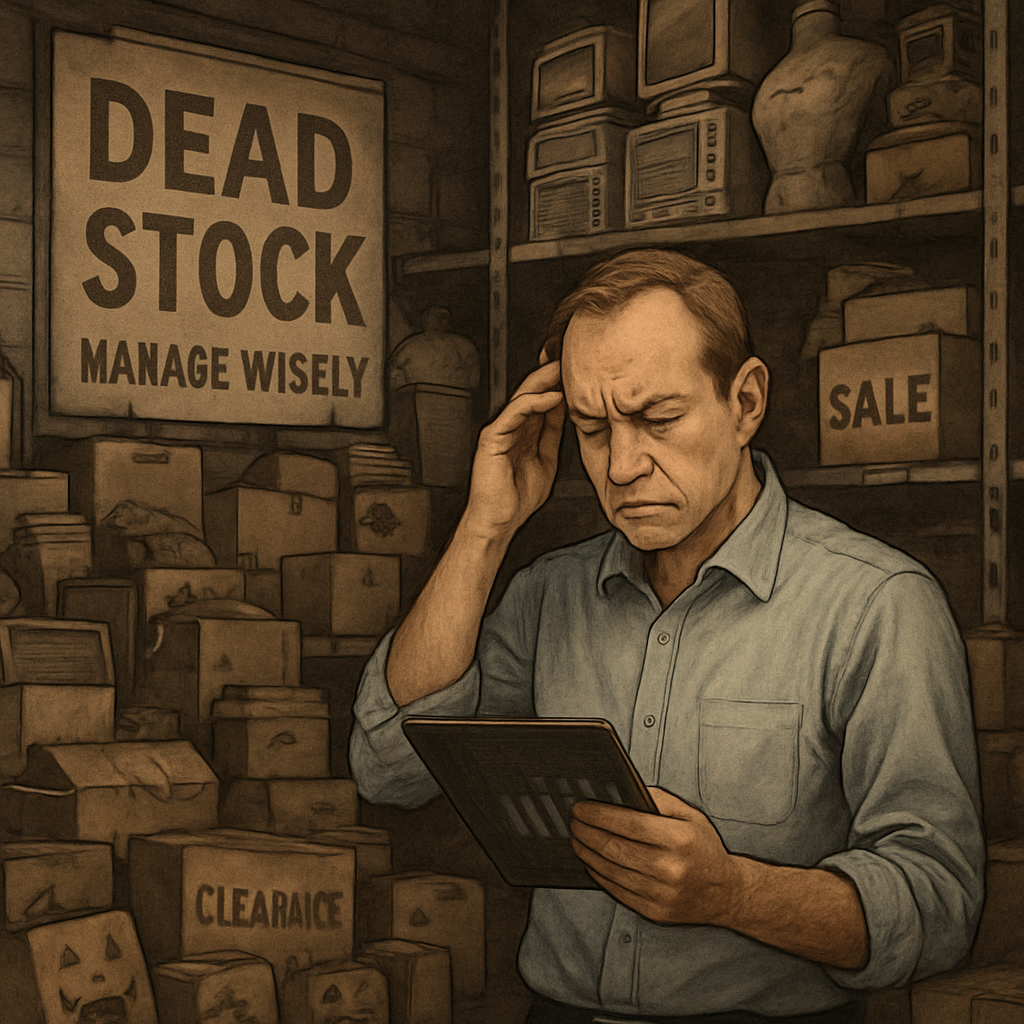

Dead stock is inventory that has little to no likelihood of selling at its current price or through normal channels. In ecommerce operations, dead stock represents trapped capital with minimal recovery potential.
Dead stock is also referred to as dead inventory; this article uses “dead stock” consistently.
1. What it is (Definition)Dead stock refers to inventory that has not sold for an extended period and shows no realistic demand without significant discounting or liquidation.
In ecommerce, dead stock often emerges from overstock that was not addressed early, discontinued products, obsolete versions, or items tied to expired trends or seasons.
Unlike slow-moving inventory, dead stock has effectively exited the demand curve. Its primary impact is financial rather than operational, as it occupies space and capital without contributing revenue.
For mid-market ecommerce brands, unmanaged dead stock can quietly erode profitability over time.
2. Who it’s forDead stock management is relevant for ecommerce brands and aggregators with broad assortments, frequent product launches, or seasonal catalogs.
Shopify-based brands accumulate dead stock when products are replaced or rebranded without fully running down prior inventory.
Amazon and Walmart 3P sellers face dead stock risk when listings lose relevance, reviews deteriorate, or algorithms deprioritize products.
Multichannel ecommerce teams often discover dead stock unevenly distributed across locations or channels, complicating recovery efforts.
3. How it worksDead stock typically forms gradually. Inventory moves from fast-moving to slow-moving, then stops selling altogether if not addressed.
Once inventory is classified as dead stock, options are limited. Recovery strategies include deep discounting, bundling, secondary marketplaces, donations, or write-offs.
Operationally, dead stock should be isolated to prevent it from distorting inventory metrics and planning decisions.
Preventing dead stock depends on early identification of slowing SKUs, disciplined assortment management, and proactive run-down strategies.
4. Key metricsInventory turnover approaches zero for dead stock, making it a clear outlier in SKU-level analysis.
Sell-through rate stagnates, revealing inventory that no longer converts to sales.
Weeks of supply becomes extremely high or undefined, as demand effectively disappears.
Fill rate is largely irrelevant for dead stock, highlighting that availability alone does not equal value.
These metrics help distinguish recoverable overstock from true dead inventory.
5. FAQIs dead stock the same as overstock?
No. Dead stock is unsellable; overstock may still sell over time.
How long before inventory is considered dead stock?
There is no fixed timeframe; classification depends on demand signals and lifecycle context.
Can dead stock be avoided entirely?
Not entirely, but it can be minimized through proactive management.
Should dead stock be written off?
Often yes, once recovery options are exhausted.
Does dead stock affect planning decisions?
Yes. It should be excluded from active inventory calculations.