
Running a lean supply chain used to mean one thing: cut costs wherever possible. Reduce headcount, negotiate harder with suppliers, squeeze every dollar out of freight. It was a game of minimization, and it came with real tradeoffs — lower safety stock meant higher stockout risk, tighter supplier terms meant less flexibility, and leaner teams meant more pressure on the people left.
AI is redefining what lean actually means for ecommerce supply chains. Not by cutting more, but by eliminating the inefficiencies that were hiding in plain sight — the overstock sitting in warehouses tying up cash, the reorder decisions made on outdated data, the hours spent building reports that were already stale by the time anyone read them.
The most efficient supply chains aren't the ones that spent the least. They're the ones that wasted the least. And increasingly, that's a distinction AI is making possible.
The Hidden Costs Eating Your Supply Chain
Before understanding what AI fixes, it's worth being honest about what's broken in most ecommerce supply chains today.
Overstock is the silent margin killer. Most ecommerce brands focus intensely on avoiding stockouts — and rightly so, because the cost of a stockout is immediate and visible. A product goes to zero, sales stop, ranking drops. The damage is measurable in real time. Understanding where ecommerce brands actually lose money in inventory makes it clear that overstock is just as dangerous as stockouts — it's just harder to see.
Overstock is more insidious. Excess inventory doesn't announce itself. It just sits there, occupying warehouse space, tying up working capital, and slowly losing value through markdowns, obsolescence, or expiry. It doesn't trigger an alert. It just quietly erodes margin over weeks and months until someone finally runs a report and realizes how much cash is buried in product that isn't moving.
Reactive decisions compound over time. Most inventory decisions are made reactively — based on what just happened rather than what's about to happen. A brand sells out of a SKU, places a rush order, pays premium freight, and vows to order more next time. Next time, they order too much, end up with overstock, and swing back the other way. This oscillation — sometimes called the bullwhip effect in supply chain theory — is one of the most common and costly patterns in ecommerce operations, and it almost always traces back to forecasting that's too slow, too manual, or too backward-looking.
Manual processes don't scale. A spreadsheet-based supply chain might work reasonably well for a brand with 50 SKUs selling on one channel. Add a second channel. Add a warehouse. Add a 3PL. Add seasonal demand. The spreadsheet doesn't get a little more complicated — it becomes unmanageable. More tabs, more formulas, more opportunities for human error, more time spent reconciling data instead of acting on it. It's exactly why so many Amazon sellers are moving from spreadsheets to AI for inventory planning.
These aren't small inefficiencies at the margins. For most growing ecommerce brands, they represent significant amounts of wasted capital, wasted time, and wasted margin.
What AI Actually Does Differently
The promise of AI in supply chain isn't that it replaces human judgment. It's that it removes the friction between data and decision — processing more information, faster, and turning it into specific recommendations that humans can act on without spending hours building the analysis first.
Forecasting That Moves in Real Time
Traditional demand forecasting works on a lag. Someone pulls sales data, builds or updates a model, reviews the output, and makes a decision. By the time that process completes, the underlying data has already changed. A demand spike happened. A competitor went out of stock. A promotional campaign moved the needle.
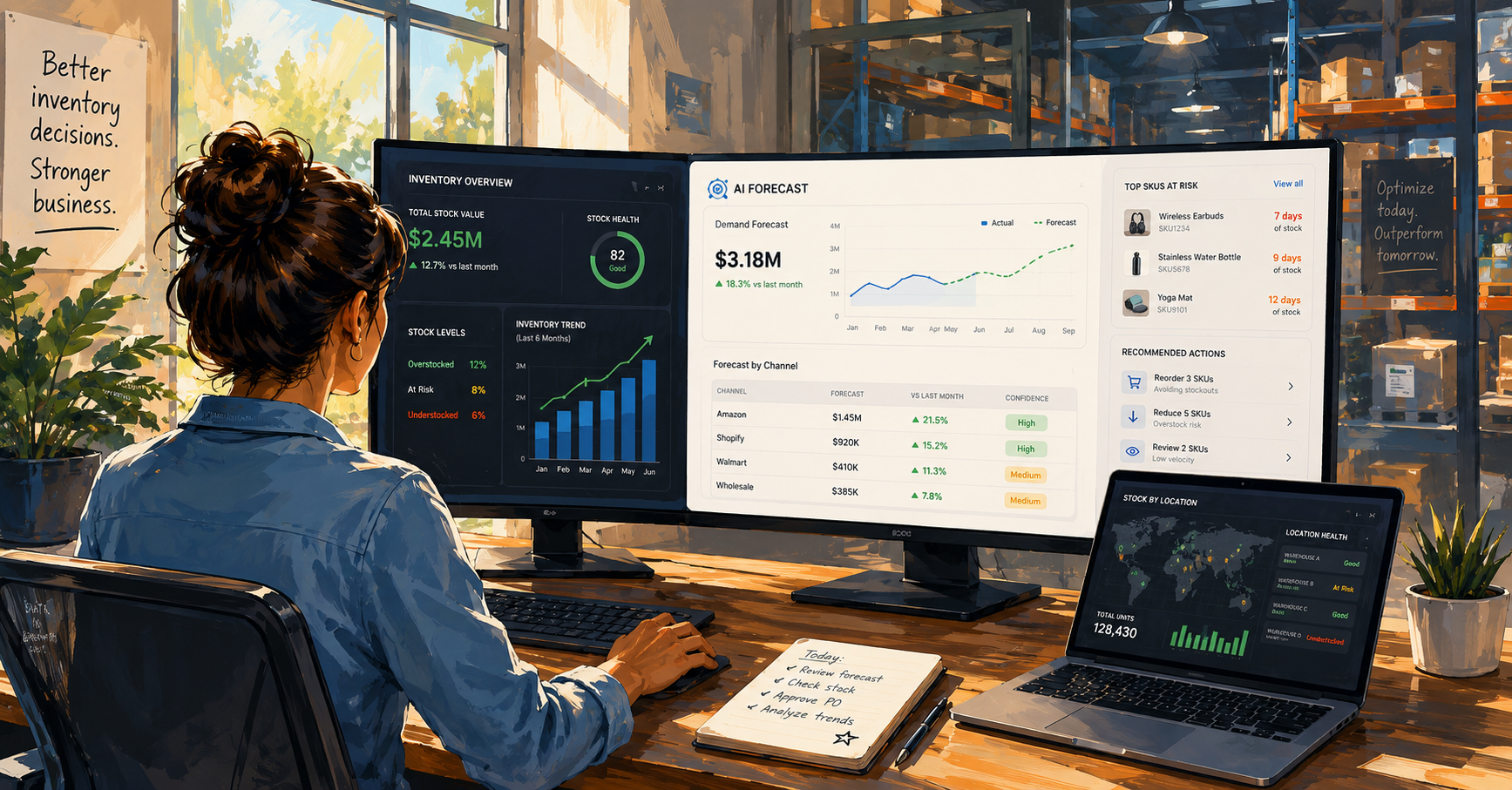
AI-powered forecasting works continuously. As sales data comes in — hourly, daily — the model updates. A SKU that started trending up this week is already reflected in the forecast, not in next month's planning cycle. For ecommerce brands navigating highly seasonal or promotion-driven demand patterns, this responsiveness isn't a nice-to-have. It's the difference between having the right inventory at the right time and constantly scrambling to catch up.
This also matters enormously across multiple channels. A brand selling on Amazon, Shopify, and wholesale doesn't have one demand signal — it has several, each with its own patterns, lead times, and customer behaviors. AI can synthesize those signals simultaneously and produce channel-specific forecasts rather than a blended average that's wrong for everyone. Understanding which demand planning models work best for ecommerce is the foundation for getting this right.
Smarter Reorder Recommendations
One of the most direct ways AI drives supply chain efficiency is through reorder recommendations that actually reflect current conditions rather than historical averages.
Reorder points are typically set based on a combination of average demand and safety stock calculations — formulas that work well in stable conditions and break down quickly when conditions change. A demand surge, a supplier delay, or a shift in sales mix can make a static reorder point dangerously wrong. AI models continuously recalibrate these thresholds based on real-time data, so the recommendation to reorder a SKU reflects what's actually happening now, not what happened on average over the past 90 days.
The result is tighter inventory — less safety stock needed because the forecast is more accurate, less overstock because reorder quantities are calibrated to actual demand rather than padded estimates. Research consistently shows that AI-driven demand planning can significantly reduce inventory carrying costs while simultaneously improving in-stock rates — a combination that was difficult or impossible to achieve with manual methods.
Eliminating Low-Value Manual Work
Perhaps the most underappreciated way AI improves supply chain efficiency is simply by automating the work that doesn't require human judgment.
Building a weekly reorder report. Checking stock levels across warehouses. Compiling a channel-by-channel inventory summary. Monitoring for SKUs approaching out-of-stock. These tasks aren't complex — but they're time-consuming, they happen repeatedly, and they pull operations teams away from higher-value work like supplier relationship management, demand sensing, and strategic planning.
AI-powered platforms can handle all of this automatically. Reports get generated and distributed on schedule. Alerts fire when inventory drops below a threshold. The data is always current. Operations teams stop spending half their week pulling numbers and start spending that time acting on them.
This shift in how operations teams spend their time is one of the most tangible efficiency gains AI delivers — and one of the hardest to quantify until you've actually experienced it. As brands like Zipstring have found, the time savings can be dramatic, with teams reclaiming dozens of hours per month that were previously consumed by manual inventory analysis.
Reducing the Bullwhip Effect
The bullwhip effect — where small fluctuations in consumer demand create increasingly large swings in orders as you move up the supply chain — is one of the most persistent inefficiencies in supply chain management. It leads to periods of excess inventory followed by periods of shortage, with the entire chain oscillating between the two.
AI dampens this effect by improving the accuracy and responsiveness of demand signals. When a brand's forecast is continuously updated with real data, it doesn't swing wildly between overestimating and underestimating demand. Orders to suppliers become more consistent, more predictable, and more appropriately sized. Suppliers benefit from this stability too — more predictable orders make their own planning easier, which can translate into better lead times and stronger supplier relationships.
The Multichannel Complexity Problem
For ecommerce brands specifically, one of the greatest drivers of supply chain inefficiency is multichannel complexity. As brands expand from a single storefront to Amazon, Shopify, wholesale accounts, retail partnerships, and international markets, the coordination challenge grows exponentially.
Each channel has different demand patterns, different lead times for replenishment, different customer expectations, and different operational requirements. Inventory that's in the right warehouse for one channel might be in the wrong location for another. A demand spike on one channel can create an unexpected shortfall on another if inventory isn't being monitored holistically.
Managing inventory across multiple channels from a single source of truth is one of the most significant operational improvements a growing ecommerce brand can make — and it's something AI-powered platforms are uniquely well-suited to enable. Rather than reconciling data across multiple disconnected systems, brands get a unified view of inventory, demand, and replenishment needs across all channels simultaneously.
From Reactive to Proactive Operations
The fundamental shift AI enables in supply chain operations is a move from reactive to proactive decision-making. Most supply chains today are reactive by design — they respond to what has happened, not what is about to happen. Stockouts get addressed after they occur. Overstock gets discovered after it accumulates. Supplier problems get identified after shipments are delayed.
AI makes proactive operations practical in a way that wasn't feasible before. When a SKU is trending toward a stockout three weeks out, the system flags it now — while there's still time to place an order within normal lead times. When a demand forecast suggests that an upcoming promotion will drive 40% higher-than-usual velocity on a specific product, the reorder recommendation already accounts for it. When a supplier's historical delivery patterns suggest a delay is likely, the system builds that uncertainty into the safety stock calculation.
This shift from reactive to proactive doesn't just improve supply chain efficiency in isolation. It changes how operations teams operate day-to-day. Less fire-fighting. More planning. Less scrambling to fix problems after they've already caused damage. More time spent on the decisions that actually move the business forward — including getting ahead of major sales events before it's too late, which is exactly why Q3 is the real window for Q4 planning.
What Lean Actually Means Now
Lean supply chain management used to be about doing more with less through reduction — fewer people, lower stock levels, tighter supplier terms. The risk was always fragility: a lean system built on minimization breaks down quickly when something unexpected happens.
AI-powered lean looks different. It's about doing more with less through intelligence — not cutting stock levels arbitrarily, but carrying exactly the right amount of stock because the forecast is accurate enough to support it. Not reducing operational headcount, but enabling the same team to operate at dramatically higher capacity because they're not spending their time on manual data work. Not squeezing supplier relationships, but building more predictable, consistent demand signals that make those relationships work better for everyone.
The most efficient ecommerce supply chains in 2026 aren't the ones that cut the most. They're the ones that waste the least — and increasingly, that's a distinction made possible by AI.
Flieber is an AI-powered demand planning and forecasting platform built for modern ecommerce brands. From real-time inventory visibility to automated reorder recommendations, Flieber helps brands carry less, sell more, and stop managing inventory in spreadsheets. Start for free at flieber.com.