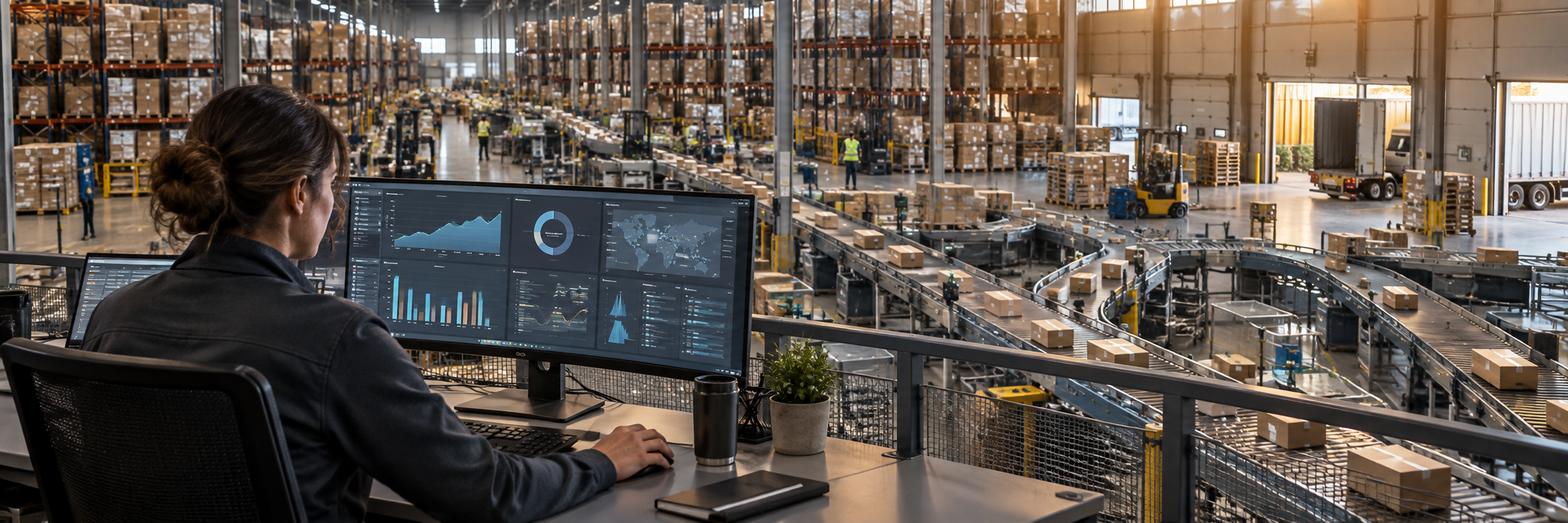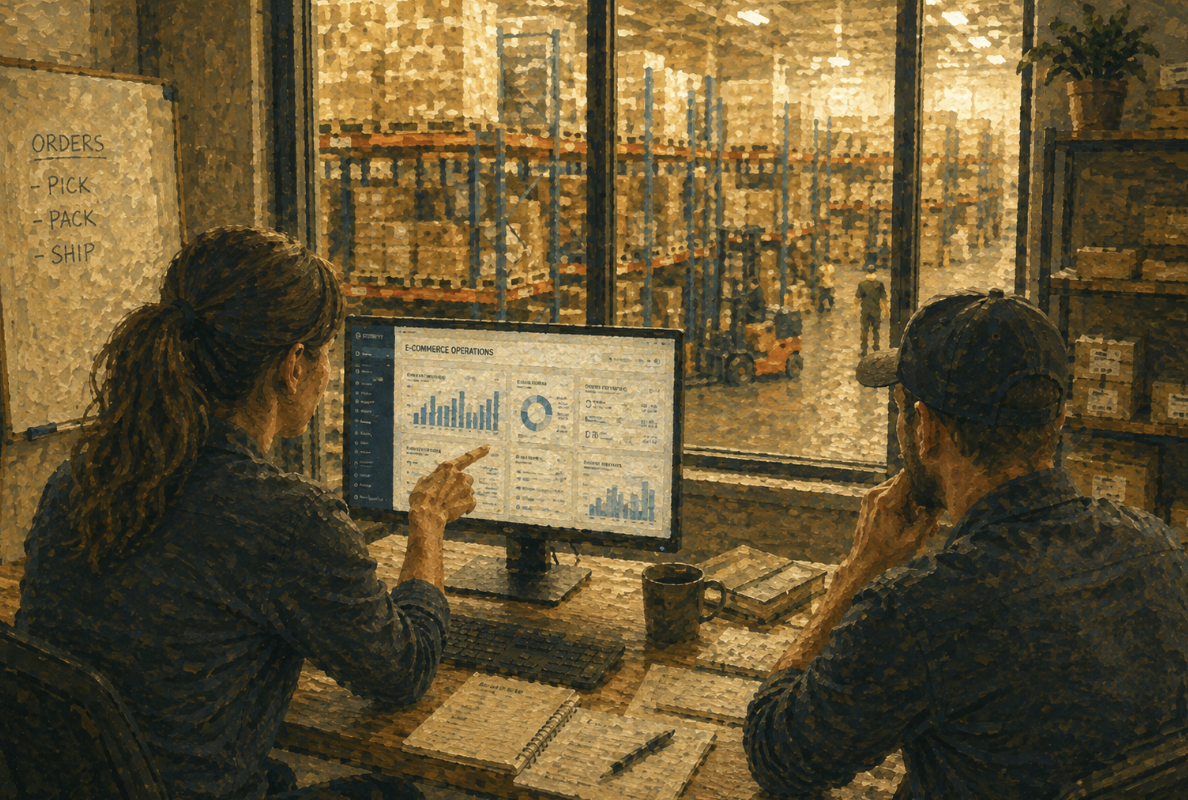

Ecommerce operations have always required teams to balance a complicated set of moving parts. Inventory needs to be in the right place at the right time, purchase orders need to account for supplier lead times, forecasts need to adjust as demand changes, and decisions across marketing, finance, and operations need to stay aligned.
As brands grow, that complexity compounds. More SKUs, sales channels, fulfillment locations, suppliers, and data sources create more opportunities for operational inefficiency. Processes that worked when a business was smaller — spreadsheets, static reports, manual data pulls, and weekly inventory reviews — become increasingly difficult to maintain at scale.
Artificial intelligence is beginning to fundamentally change that equation. AI isn't simply giving ecommerce teams another way to analyze their data. It's changing how quickly businesses can identify problems, make decisions, and act on them.
For ecommerce brands, the shift is significant. The companies that use AI effectively won't necessarily replace their existing operational expertise. Instead, they'll be able to apply that expertise faster and across far more data than a human team could realistically process on its own.
The Growing Complexity of Ecommerce Operations
Managing ecommerce operations can be relatively straightforward in the early stages of a business. A limited assortment, one or two sales channels, and a small supplier network can often be managed with spreadsheets and relatively simple processes.
Growth changes that equation.
A multichannel brand may have inventory distributed across Amazon FBA, its own fulfillment network, third-party logistics providers, retail partners, and wholesale accounts. Each channel can have different sales velocities, replenishment requirements, fees, lead times, and service-level expectations.
At the same time, demand is becoming less predictable. Promotions, marketplace events, seasonality, social media trends, competitor activity, and paid advertising can quickly change how individual products perform.
This is one reason growing brands tend to move beyond spreadsheets and toward AI-powered inventory planning. The problem isn't necessarily that spreadsheets stop working. It's that the amount of manual effort required to keep them accurate increases as the business becomes more complex.
AI gives ecommerce teams a way to process that complexity at scale.
AI Is Making Forecasting More Responsive
Demand forecasting is one of the clearest examples of how AI is reshaping ecommerce operations.
Traditional forecasting models typically rely heavily on historical sales data and manually configured assumptions. While historical performance remains important, ecommerce demand is influenced by far more than what happened last month or last year.
Seasonality, promotions, product lifecycle, sales velocity, supplier lead times, channel-specific demand, and unexpected changes in consumer behavior can all affect what a brand should order and when.
AI-powered systems can analyze larger volumes of data and continuously update forecasts as new information becomes available. Rather than treating the forecast as a static number that gets revisited during the next planning cycle, teams can work from a more dynamic view of expected demand.
That matters because even small forecasting improvements can have a meaningful impact on the business. Ordering too little can lead to stockouts and lost revenue, while ordering too much ties up working capital in inventory that may take months to sell.
Effective inventory optimization for ecommerce brands depends on finding the balance between product availability and the cost of carrying excess stock. AI can help teams make that balance more precise by identifying patterns and risks that are difficult to evaluate manually.
Operational Data Is Becoming Easier to Use
AI is also changing how ecommerce teams interact with their data.
Most brands aren't lacking information. The problem is that information often lives across multiple platforms, spreadsheets, dashboards, and reports. Finding an answer can require downloading data, manipulating a spreadsheet, configuring a dashboard, or waiting for someone with the right technical knowledge to pull a report.
Generative AI introduces a different interface: natural language.
Instead of navigating through reports to determine which SKUs are at risk of stocking out, an operator can increasingly ask that question directly. The same applies to questions about inventory coverage, purchase orders, supplier performance, sales velocity, or expected demand.
It's a shift from simply managing inventory to having a conversation with your data. As we explored in Stop Managing Inventory and Start Talking to It, natural-language interfaces can remove much of the friction that has traditionally existed between ecommerce teams and their operational data.
When teams can ask questions in plain language, access to information becomes less dependent on knowing exactly where that information lives or how a particular report is structured.
That can have an important organizational effect as well. Founders, finance teams, marketers, and operators can work from the same underlying information without each needing to become an expert in the systems used to retrieve it.
AI Can Identify Problems Before They Become Emergencies
Many operational problems become expensive because teams identify them too late.
A product may be selling significantly faster than forecast, but no one notices until inventory is approaching zero. A supplier shipment may be delayed, but its impact isn't obvious until the expected arrival date gets dangerously close. Inventory may be accumulating at one location while another location moves toward a stockout.
AI can continuously monitor operational data for these kinds of exceptions.
Instead of relying entirely on employees to identify problems during periodic reviews, AI-powered systems can surface unusual activity as it happens. That allows teams to focus their attention on the SKUs, orders, or locations that actually require intervention.
This becomes particularly valuable as a brand scales. A planner may be able to manually review 50 SKUs in detail. Reviewing 5,000 SKUs with the same level of attention is a different challenge entirely.
As we've explored in our guide to AI inventory management, automation becomes increasingly valuable when the volume of variables exceeds what teams can reliably evaluate manually. Instead of adding more manual processes as the business grows, brands can use AI to identify the exceptions that actually require human attention.
Ecommerce Operations Are Moving From Analysis to Action
Perhaps the most important development in AI is the transition from systems that simply provide information to systems that can help execute operational workflows.
Consider a common replenishment process. A team identifies products that need to be reordered, determines quantities, groups products by supplier, creates purchase orders, routes them for approval, and communicates with vendors.
AI can assist at multiple points in that process. It can identify replenishment needs, calculate recommended quantities, organize products by supplier, draft purchase orders, and surface the final recommendation for human approval.
The same concept can apply to other operational workflows. Teams can monitor purchase orders for delays, identify inventory imbalances between locations, generate recurring inventory reports, or trigger alerts when predetermined conditions are met.
The result isn't necessarily a fully autonomous operation. Instead, AI can handle more of the repetitive analysis and administrative work surrounding a decision while the team maintains control over the decision itself.
This represents an important evolution in ecommerce technology. The value of AI isn't limited to providing a better forecast or another dashboard. Increasingly, its value comes from connecting insights to the workflows that follow them.
AI Is Creating Leaner Ecommerce Operations
The operational value of AI ultimately comes down to efficiency.
Historically, scaling an ecommerce business often meant scaling the team and its processes alongside it. More orders and SKUs required more planning, more reporting, more spreadsheets, and more people managing the growing volume of information.
AI changes that relationship.
A smaller operations team can potentially manage greater complexity because technology handles more of the repetitive work involved in monitoring, analyzing, and organizing operational data. This is already contributing to leaner and more efficient ecommerce supply chains, where teams can focus their time on the exceptions and decisions that genuinely require human judgment.
That doesn't make experienced operators less important. In many ways, it makes their expertise more valuable.
Instead of spending hours gathering information before making a decision, they can spend more of their time evaluating recommendations, managing supplier relationships, planning scenarios, and making strategic tradeoffs.
The goal isn't to remove humans from ecommerce operations. It's to remove as much unnecessary manual work as possible from the decisions humans are responsible for making.
From Manual Operations to Intelligent Operations
The evolution of ecommerce operations isn't simply about automating individual tasks. It's about changing the way teams interact with their data and manage their businesses.
In a manual operating model, teams are responsible for finding the information, interpreting it, identifying the problem, determining the next step, and carrying out the action.
In an intelligent operating model, technology can help continuously monitor the business, surface the information that matters, recommend an appropriate response, and automate parts of the workflow — while keeping the team in control of the decisions that require human judgment.
For growing ecommerce brands, this creates an opportunity to build operations that become more intelligent as they scale rather than simply more complicated.
Flieber is building toward that model by combining AI-powered inventory planning with tools that help commerce teams turn operational data into actionable workflows. Brands can use Flieber to improve forecasting and replenishment while creating more intelligent ways to monitor data, identify risks, and act on operational insights.
As AI continues to develop, the biggest operational advantage may not come from having more data. Most ecommerce brands already have plenty of it. The advantage will come from how quickly a business can understand that data, make the right decision, and turn that decision into action.
Turn Your Ecommerce Operations Into an Intelligent System
Flieber helps modern commerce teams move beyond manual inventory management with AI-powered forecasting, replenishment, and operational tools built for the complexity of multichannel ecommerce. With Flieber, your team can spend less time pulling reports and managing spreadsheets and more time making faster, data-driven decisions.
See how Flieber can help you build smarter ecommerce operations.