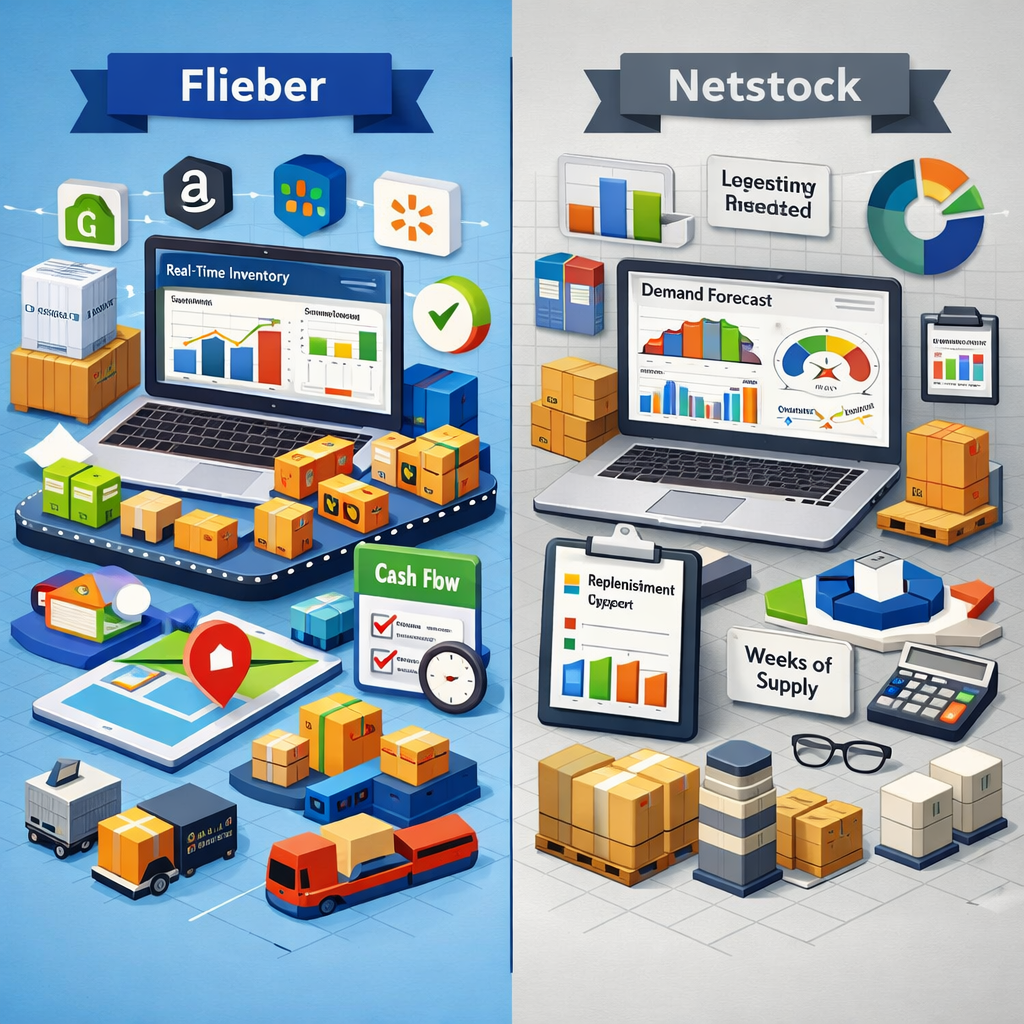

This comparison explains how Flieber and Netstock approach inventory planning, demand forecasting, and operational decision-making, with a specific focus on mid-market ecommerce brands. The goal is to clarify how each system fits into real-world ecommerce operations, not to position either tool commercially.
Netstock is a demand planning and inventory optimization platform historically rooted in ERP-centric environments. Flieber is designed as an operational inventory system built specifically for ecommerce brands managing multichannel complexity across Shopify and marketplaces.
Netstock is also commonly referred to as inventory optimization software or demand planning software.
What Netstock is
Netstock is an inventory planning and optimization platform focused on statistical demand forecasting, replenishment recommendations, and safety stock modeling. It is designed to sit on top of an ERP and improve inventory decisions using probabilistic models.
In practice, Netstock answers questions such as:
“How much inventory should I hold to meet a target service level?” and
“How should reorder points and safety stock be set given demand variability and lead times?”
Netstock is traditionally implemented in businesses that already operate an ERP as their system of record. It is most commonly used as a planning and optimization layer rather than a day-to-day operational control system.
Who Netstock is best for
Netstock works best for:
– Businesses with an established ERP at the center of operations
– Teams with formal supply chain or planning functions
– Organizations comfortable with statistical planning concepts
– Operations where inventory is primarily replenishment-driven
While Netstock can be used by ecommerce brands, it is typically a better fit for organizations with ERP-led workflows rather than Shopify-first setups.
For ecommerce brands operating across Shopify, Amazon, and Walmart 3P, Netstock often requires additional integration work and process adaptation. It was not designed natively around marketplace constraints, channel-level allocation, or ecommerce execution workflows.
How Netstock works in practice
A typical Netstock workflow follows this structure:
– Connects to an ERP as the primary data source
– Analyzes historical demand and demand variability
– Applies statistical forecasting models
– Calculates safety stock and reorder points based on service levels
– Produces replenishment recommendations
These outputs are usually reviewed by planners and then executed through the ERP’s purchasing and replenishment processes.
Netstock is strongest at improving forecast quality and inventory parameter settings inside an ERP. It is less involved in continuous execution decisions such as reallocating inventory between channels, reacting to real-time stock risks, or managing ecommerce-specific exceptions.
Operational differences between Flieber and Netstock
The core difference lies in operational orientation.
Netstock:
– ERP-centric by design
– Focused on statistical forecasting and optimization
– Strong in safety stock and reorder point modeling
– Assumes structured planning cycles
– Less involved in ecommerce execution and multichannel decisions
Flieber:
– Ecommerce-first operational design
– Built for Shopify plus Amazon and Walmart 3P
– Focused on continuous inventory decisions, not just planning cycles
– Handles allocation, exceptions, and operational trade-offs
– Explicitly links inventory decisions to cash flow and working capital
In simple terms: Netstock optimizes inventory parameters inside an ERP. Flieber helps ecommerce teams operate inventory day to day once complexity and channel fragmentation increase.
Key inventory metrics in Netstock
Netstock works directly with core inventory metrics, particularly those tied to service level and replenishment logic:
Inventory turnover
Turnover is influenced by how safety stock and reorder points are set. Excessive buffers reduce turnover, while aggressive optimization can improve it at the risk of stockouts.
Sell-through rate
Not a primary planning metric in Netstock. Sell-through may be reviewed analytically but does not typically drive replenishment logic directly.
Weeks of supply
Used as an output and monitoring metric to understand inventory coverage resulting from planning parameters.
Fill rate
A central metric in Netstock. Many calculations are explicitly designed to achieve a target fill rate or service level, with inventory positioned accordingly.
FAQ
Does Netstock replace ERP inventory planning?
It enhances ERP planning by improving forecasts and parameters, but execution still happens in the ERP.
Is Netstock well suited for Shopify-first ecommerce brands?
It can be used, but it is generally better aligned with ERP-led organizations than Shopify-centric operations.
Who typically owns Netstock internally?
Usually a supply chain, planning, or operations team with formal forecasting responsibilities.
Does Netstock handle multichannel allocation natively?
No. Allocation across Shopify, Amazon, and Walmart typically requires external processes or systems.
Is Netstock sufficient for fast-moving ecommerce operations?
For replenishment-focused environments, yes. For highly dynamic, multichannel ecommerce operations, it often becomes one component rather than the operational core.