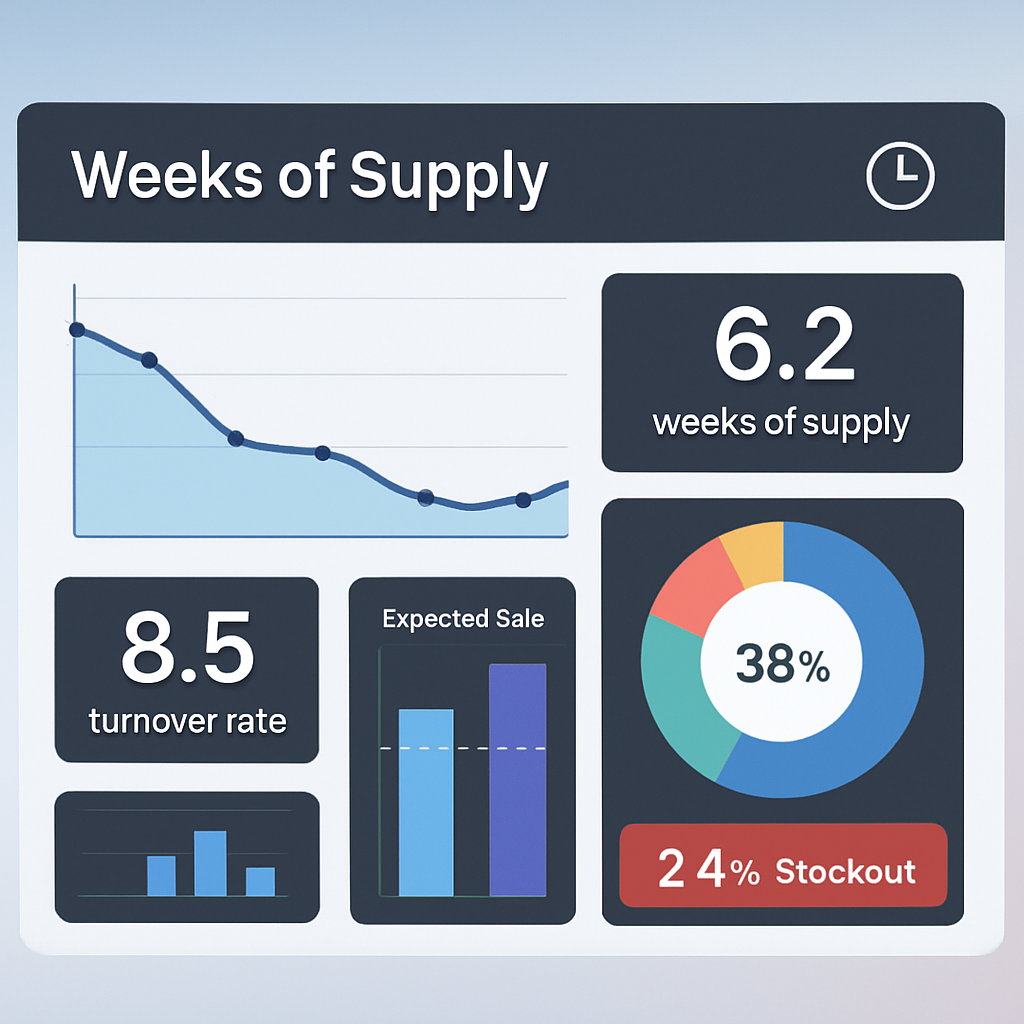

Weeks of supply in ecommerce operations is a time-based inventory metric that indicates how long current stock will last given an expected sales rate. It translates inventory quantities into weeks of coverage to assess stockout and overstock risk.
1. What it is (Definition)
Weeks of Supply (often abbreviated as WOS) is an inventory metric that expresses how long current inventory is expected to last, measured in weeks, given an expected rate of sales. In ecommerce operations, it translates inventory quantities into time-based coverage, making inventory risk easier to understand and manage.
Instead of asking “how many units do we have,” weeks of supply asks “how much time do we have before we run out.” This time-based view is especially useful in environments where demand fluctuates and replenishment lead times are long or variable.
Weeks of supply is a forward-looking metric. It depends on an assumed sales rate, typically derived from recent historical sales or a demand forecast. As demand expectations change, weeks of supply changes even if inventory quantity stays the same.
For ecommerce brands, weeks of supply is one of the most practical metrics for balancing availability and cash efficiency. It connects inventory levels directly to urgency and risk.
2. Who it’s for
Weeks of supply is particularly valuable for mid-market ecommerce brands and aggregators operating between $5M and $100M in annual revenue. At this stage, inventory investment is significant, and teams need clear signals to prioritize replenishment and manage risk.
Shopify-based ecommerce operations use weeks of supply to manage fast-moving and slow-moving SKUs across promotions, launches, and seasonal swings. It provides a common language between merchandising, operations, and finance.
Amazon and Walmart third-party sellers rely heavily on weeks of supply to avoid stockouts that harm marketplace performance while also limiting excess inventory that drives storage fees. Time-based visibility is more actionable than unit counts in these environments.
Multichannel ecommerce teams managing shared inventory pools use weeks of supply to understand total coverage across channels. It helps prevent situations where inventory looks sufficient in one channel but is actually at risk when aggregate demand is considered.
Weeks of supply becomes increasingly important as SKU count grows and inventory decisions must be made quickly and consistently.
3. How it works
Weeks of supply is calculated by dividing current available inventory by the expected average weekly sales rate. While the math is simple, the operational value depends on how the sales rate is defined.
In practice, teams choose a sales rate that reflects near-term demand. This may be based on recent sales, seasonally adjusted averages, or a demand forecast. The chosen rate should align with how the business expects inventory to be consumed.
Once calculated, weeks of supply is monitored continuously. As sales occur, inventory declines and weeks of supply decreases. As inbound inventory is received, weeks of supply increases. Changes in demand expectations also affect the metric even if inventory does not move.
Weeks of supply is often used to trigger actions. Low weeks of supply signals replenishment urgency or allocation adjustments. Excessively high weeks of supply signals overstock risk and may prompt slower purchasing, reallocation, or promotional activity.
In effective operations, weeks of supply is reviewed alongside lead times. Inventory should not only last until today’s demand is met, but long enough to cover sales until the next replenishment arrives.
4. Key metrics
Inventory turnover and weeks of supply are closely related. High inventory turnover generally corresponds to lower weeks of supply, indicating faster inventory flow. Low turnover corresponds to higher weeks of supply, signaling slower-moving stock and higher capital exposure.
Sell-through rate complements weeks of supply by showing how quickly inventory is converting into sales within a defined period. High weeks of supply combined with low sell-through typically indicates overstock or weak demand alignment.
Weeks of supply itself is a primary planning metric. It translates inventory into time-based risk, making it easier to compare SKUs with different sales volumes and price points.
Fill rate reflects the service impact of weeks of supply decisions. Holding too few weeks of supply increases stockout risk and reduces fill rate. Holding too many weeks of supply may protect fill rate but at the cost of cash efficiency.
Together, these metrics help teams balance speed, coverage, and service. Weeks of supply sits at the center by making inventory risk visible in time units.
5. FAQ
Is weeks of supply the same as days of inventory?
They represent the same concept at different time scales. Weeks of supply uses weeks instead of days for easier planning at a mid-term horizon.
Does a lower weeks of supply always mean better performance?
No. Lower weeks of supply improves cash efficiency but increases stockout risk if replenishment is delayed or demand spikes.
How should the sales rate be chosen for weeks of supply?
It should reflect expected near-term demand, often using recent sales adjusted for seasonality or known changes.
Can weeks of supply be used for slow-moving items?
Yes. It is often most revealing for slow movers, where unit counts can be misleading but time-based coverage highlights excess.
How often should weeks of supply be reviewed?
It should be monitored continuously, with regular reviews to trigger replenishment or corrective actions before issues arise.