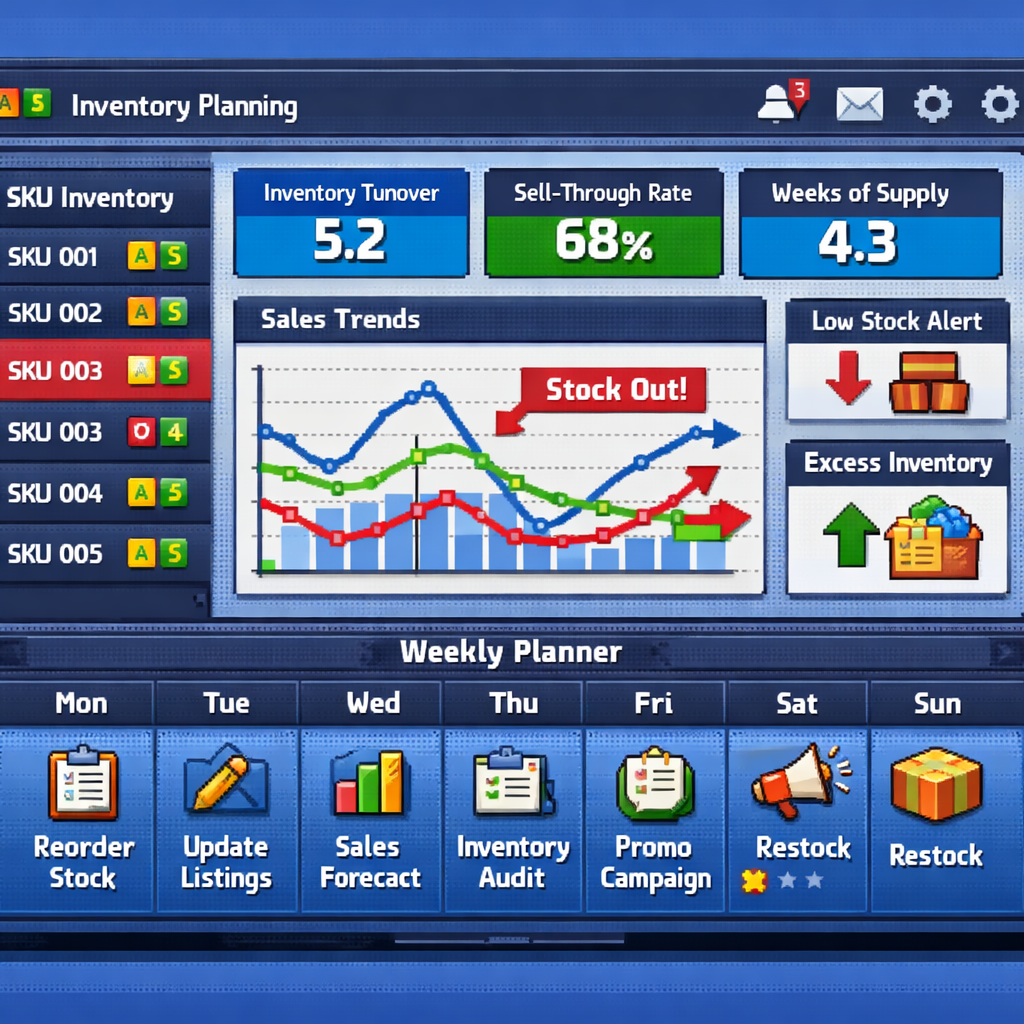

Best Amazon and Shopify inventory planning tools refer to systems designed to plan, allocate, and replenish inventory across a Shopify DTC store and Amazon third-party marketplaces using a single operational logic. For mid-market ecommerce brands, these tools exist to prevent channel conflict, stockouts, and excess inventory caused by disconnected planning.
Amazon and Shopify inventory planning tools are also commonly referred to as multichannel inventory planning software. In this article, the term Amazon and Shopify inventory planning tools is used consistently.
1 What it is (Definition)
Amazon and Shopify inventory planning tools are systems that coordinate inventory decisions across direct-to-consumer and marketplace channels. They combine sales data, inventory positions, and supply constraints to support unified planning rather than channel-by-channel optimization.
Unlike basic inventory sync tools that only update stock counts, inventory planning tools focus on forward-looking decisions. They help teams determine how much inventory to buy, how to split it between Shopify and Amazon, and when to replenish each channel.
For ecommerce brands selling on both Shopify and Amazon, these tools act as a single planning layer. They reduce the risk of overselling, prevent one channel from starving another, and provide clarity on where inventory should be allocated as demand shifts.
2 Who it’s for
Amazon and Shopify inventory planning tools are built for ecommerce brands and aggregators operating between $5M and $100M in annual revenue. These businesses typically run a Shopify-based DTC store while selling on Amazon as third-party sellers, often using a mix of FBA and merchant-fulfilled inventory.
They are especially relevant for teams struggling with inventory fragmentation. Common symptoms include stockouts on Amazon while inventory sits unsold for DTC, or aggressive DTC promotions draining inventory needed to maintain marketplace availability.
Operations and supply chain teams are the primary users, with finance closely involved due to the capital impact of inventory allocation decisions. Marketing and channel managers benefit indirectly by having clearer inventory constraints during promotions and launches.
For this ICP, Amazon and Shopify inventory planning tools are not about maximizing each channel independently. They exist to optimize inventory performance across the business as a whole.
3 How it works
Amazon and Shopify inventory planning tools ingest sales data from both channels, typically at the SKU and time-period level. Inventory positions are pulled from warehouses, 3PLs, and marketplace fulfillment programs such as Amazon FBA.
The software normalizes this data to create a unified view of demand and inventory. It evaluates how quickly inventory is selling on each channel and how long current stock will last given recent sales patterns.
Planning logic then determines replenishment needs and allocation priorities. Teams can decide whether to reserve inventory for Amazon to protect marketplace rankings, or shift inventory toward Shopify during high-margin promotional periods.
These tools also account for supply constraints such as lead times, inbound purchase orders, and transfer delays. This allows teams to anticipate future shortages and act earlier, rather than reacting once a channel runs out of stock.
Most teams operate on a weekly planning cadence. During each cycle, they review channel-level demand, inventory coverage, and upcoming risks, then adjust purchase plans or allocations accordingly.
4 Key metrics
Inventory turnover is a core metric supported by Amazon and Shopify inventory planning tools. By aligning inventory allocation with actual demand across channels, teams avoid excess stock buildup and improve overall inventory velocity.
Sell-through rate helps identify how effectively inventory is converting into sales on each channel. Planning tools use sell-through to highlight SKUs that are underperforming on one channel while performing well on another.
Weeks of supply is a critical planning metric in multichannel environments. It allows teams to compare inventory coverage across Shopify and Amazon and prioritize replenishment based on time-based risk rather than unit counts.
Fill rate reflects how consistently customer demand is met without stockouts. While fill rate is not always directly optimized, inventory planning tools improve it indirectly by preventing unexpected channel-level stockouts.
The value of these tools lies in showing how these metrics interact across channels. Improving fill rate on Amazon may reduce sell-through on Shopify, or vice versa. The software makes these trade-offs visible so decisions are deliberate.
5 FAQ
Why is inventory planning different for Amazon and Shopify together?
Because demand patterns, service expectations, and inventory risks differ by channel, requiring coordinated allocation rather than independent planning.
Can Shopify inventory tools handle Amazon planning on their own?
Shopify tracks stock but does not provide channel-aware planning or allocation logic for Amazon marketplaces.
Who should own Amazon and Shopify inventory planning?
Ownership typically sits with operations or supply chain, with finance involved to align inventory decisions with cash flow.
How often should inventory be planned across both channels?
Most mid-market teams plan weekly to balance responsiveness with operational stability.
How do these tools prevent channel conflict?
They provide a unified view of inventory and demand, allowing teams to allocate stock intentionally instead of reacting to whichever channel sells first.